In the competitive world of logistics and transport, choosing the right wooden pallet is a strategic decision that can significantly impact the safety of your goods and the optimization of your costs. Within this structure, there is a small but crucial component that is often overlooked: the wood block or runner (cuña/taco)..
This definitive guide will provide you with the necessary knowledge to understand the importance of this element, ensuring that the foundation of your pallets is as robust and functional as the rest of the structure.
The Heart of Stability: The Wood Block or Runner
Every pallet that can be lifted from all four sides (a four-way entry pallet) owes its design and stability to the blocks or runners. These blocks separate the top and bottom deck boards, creating the vital space for the forklift tines (forks).
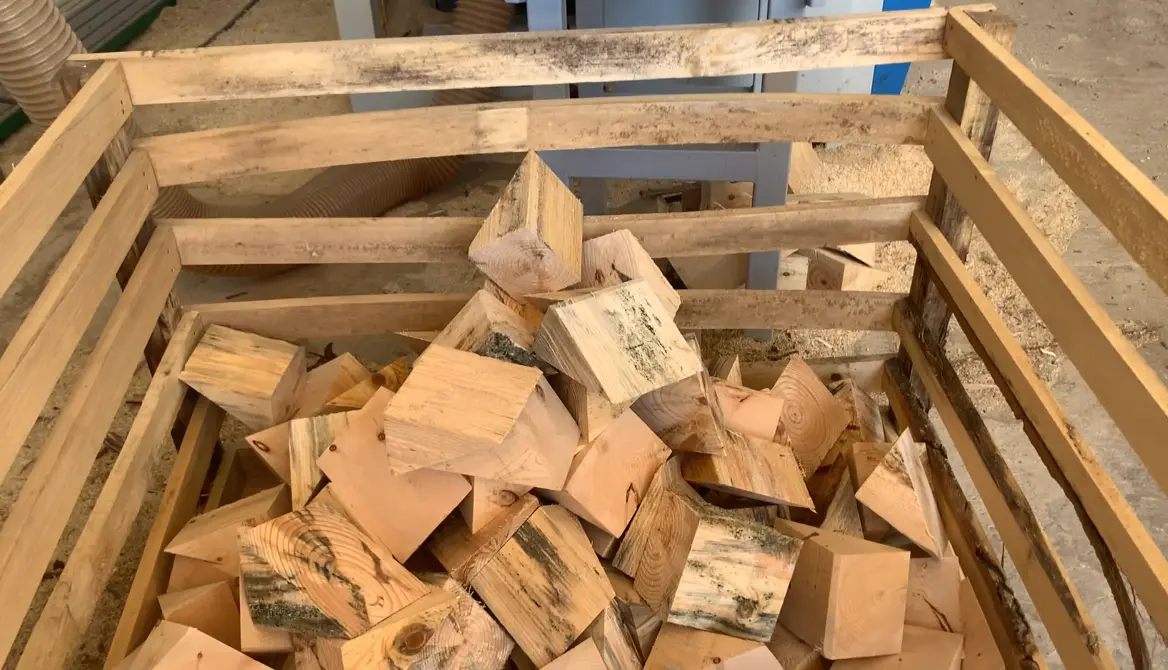
In our sawmill, the manufacturing process of these blocks is a meticulous task, as seen in the images where the machinery precisely cuts and profiles the wood blocks. The quality of the block guarantees the compression resistance and integrity of the pallet when handled.
Wood Selection for Blocks
The wood used for the blocks must be capable of withstanding extreme compression forces and resisting constant impact from machinery.
- We prioritize dense softwoods like pine or spruce for their excellent structural load capacity. These woods offer a cellular matrix strong enough to maintain the block's shape under tons of weight.
- Fabrication Consistency: It is vital that the moisture content and cut are consistent so that all blocks bear the same load, preventing weak points in the pallet structure.
Keys to Identifying a Good Runner and its Functionality
To make the right decision, it is essential to consider a series of factors that determine the quality and performance of the pallet blocks.
1. Key Functionality: Compression Resistance
The runners are the main point of support between the load and the ground. Their primary function is to absorb and distribute the load supported by the pallet, both at rest (static load) and during handling (dynamic load).
- No Deformation: A good block should not show signs of crushing or cracking even after multiple load and unload cycles. Consistency in size and cut quality is crucial for uniform weight distribution.
2. Defect Detection: Weak Points
A poorly-made block is a risk to all the goods.
- Large or Loose Knots: A knot that runs through most of the block can drastically reduce its compression resistance, creating a point of failure. Avoid blocks with large, unsound knots.
- Checks or Splits: Cracks that extend across the block section are indicators of poor drying or internal stresses, and they are points where the structure will collapse under pressure..
3. The Importance of Drying (Moisture)
Although a pallet does not require the same level of drying as a construction beam, the moisture content of the blocks is vital for their strength.
- “Green” Wood:Wood with high moisture content is less resistant to compression. If the blocks dry after the pallet is assembled, they can shrink or crack, loosening the nails that hold the boards and compromising stability.
- Dimensional Stability: Controlled drying ensures that the block maintains its shape and strength, guaranteeing that the pallet retains its load capacity over time.
The Importance of Certifications for the Runner
The robustness and legality of the blocks are not just a matter of aesthetics or strength, but of regulatory compliance in a global market.
NIMF 15 Standard: Applied to the Heart of the Pallet
The International Standard for Phytosanitary Measures No. 15 (NIMF 15) requires that all wood used in the pallet (including the blocks) be treated to prevent the spread of forest pests.
- Heat Treatment (HT): The block wood is subjected to heat to reach an internal temperature of 56°C for a minimum of 30 minutes.
- The Stamp: A NIMF 15 certified pallet (with its distinctive stamp) guarantees that every component, including the runner, complies with the necessary treatment for global export operations.
PEFC and FSC Certifications: Sustainability from the Root
The sustainable origin of the wood is fundamental. PEFC and FSC certifications guarantee that even the wood used for these structural blocks comes from responsibly managed forests, contributing to an ethical and environmentally friendly supply chain.
Cost Optimization: The Security of a Good Block
Choosing pallets whose blocks have been cut from quality, correctly dried, and certified wood is an investment that translates into long-term savings. A robust and well-made block prevents structural failures that could lead to pallet collapse and the total loss of goods.
Do not underestimate the importance of this small component. It is the foundation that supports your logistics.
In our sawmill, we advise you to find the optimal solution, ensuring that every euro invested in your pallet wood, from the boards to the blocks, translates into efficiency and safety for your business.
Ready to take the next step?
Contact us and discover how our high-quality, certified pallets and runners, tailored to your needs, can transform your logistics. Your goods deserve a solid foundation, and we provide it!